Archive for the 'IN THE MEDIA' Category

And Then Theres Grody…

Champion coonhound takes one title after another
By KAREN LAND
For the Great Falls Tribune

Because I tend to write about canines in my column, readers send and tell me all kinds of great stories about their furry, devoted friends. I love hearing what people do with their dogs. Whether your pooch is a hunter or herder, puller or playmate, guard dog or bed-warmer, his job is important. Our dogs take us places we might never go alone.Recently, I received updates from two Great Falls residents whose dogs are leading them to unusual challenges, beautiful country and new friends.”Whatever happened to Ruby, the coonhound, or Grody, the canicross dog?” you might be asking. Well, I’ll tell ya.

In June 2005, I wrote about Todd Seymanski and his Black and Tan hound dog named Ruby.Ruby’s been a busy girl since I last saw her. Todd and his wife, Debbie, and daughter, Tia, 13, have spent the last four years driving to United Kennel Club (UKC) events and field trials in Montana, Wyoming, North and South Dakota, Oregon, Washington, Utah, Arizona, Oklahoma, Minnesota and Indiana.

And all of the travel was worth it.

“Last fall, Ruby became the second coonhound in UKC history to make it to five titles,” Todd explained. “She just missed being the first dog to do so by a week, a male hound got all five titles just the week before. But she’s still the first female and first Black and Tan hound in UKC history to earn all five titles.”

Ruby is now a Grand Field Champion, Grand Night Champion, Grand Show Champion, Water Champion, and Confirmation Champion.

“The water championship was the hardest,” Todd said.

In water racing, a pulley system drags a stuffed coon across a body of water and up a tree on the other side. The hounds, simultaneously released from their starting chutes, leap into the water and swim, chasing the coon to shore. The first hound to the tree wins.

“Water racing is a male-dominated sport. In Utah, we made it to the final four which was exceptional. But we were feeling pretty small at the starting line - the three males must have weighed 70 pounds a piece while Ruby’s just about 52 pounds. But she beat them all. That says a lot for her head and her heart. Ruby’s got desire.”

Todd and Ruby are taking a short break, but that doesn’t mean they’ve stopped training. Todd runs his dogs three days a week, logging 6-7 miles a day. On the other days when it’s warm enough, he swims Ruby in the Missouri River. Todd ties a raccoon hide and a milk jug to a long rope and tosses it out into the water; Ruby swims against the current, power-housing her way up stream after the elusive coon.

“Most dogs are good at one thing or another,” Todd says. “But Ruby’s unusual. She’s an all-around balanced dog. She’s pretty good at everything she does. We’re going to keep working on getting Grand Champion in Water and Confirmation. And then she’ll have it all.”

Then there’s Grody

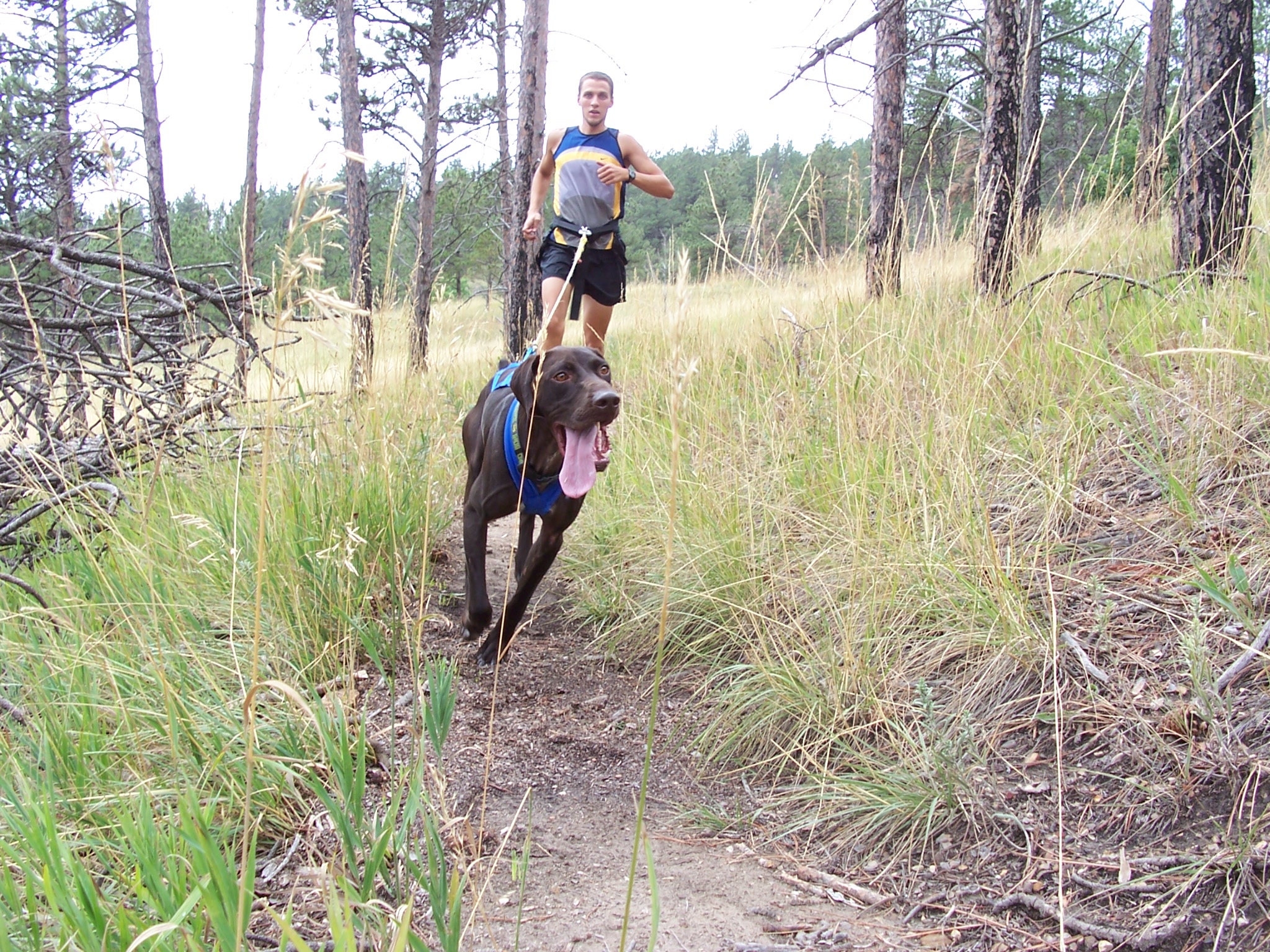
In my August 2007 column, I wrote about the new, exciting and half-crazy sport called canicross. Canicross is a dog-powered cross-country competition where a harnessed dog pulls a human runner.Nolan Taylor introduced me to the highly competitive sport that is already quite popular in Europe and South America. At the time of my column, Nolan was training with Grody, his year-old German Shorthair Pointer, in preparation for the East Meets West Dryland Challenge in Brainerd, Minn. Nov. 17-18, 2007.

“So you know the routine…” Nolan wrote me in an e-mail after the race. “Train for nearly a year, put in tons of time and money, show up at a race, and one time in a hundred things go just about as perfect as you imagine! That’s how things went this weekend.”

Nolan’s words were an understatement. He and Grody won the pro-class division of canicross with insanely fast runs of 7:02 for the 1.7 mile course on the first day and 7:03 for the same trail on day two.

“We ran two days of 4:08-ish miles,” Nolan said. “That gave us a two-day total of 3 minutes and 30 seconds faster than our closest competitor.”

In the starting chute, Grody knew what was coming up.

“When there was just 10 seconds left in the countdown, Grody started hitting the harness and screaming this crazy, wild scream - the sound of pure joy.”

Nolan says one of the best parts of going to canicross competitions is seeing people and dogs of all shapes and sizes having fun together.

“This one lady in the sportsman class was running with her English Bulldog,” he said. “I’m not sure who was working harder. One of the good parts of dryland racing is seeing everyone giving it a shot.”

May your pooch take you to great places in 2008. Happy New Year.

Keep up with Karen Land at www.mymusher.com.

No Comments »

Dry mushing in Minnesota, mon

by John Woestendiek of The Baltimore Sun

As we’ve been pointing out for a few days now, dog sledding is no longer just something to do in the snow.

This weekend there will be more proof of that when dryland mushers from across the U.S. gather in Brainerd, Minn., for the East Meets West Dryland Challenge.

With the absence of snow in many parts of North America — and global warming cutting down on the amounts of it in normally snowy climes — mushers have turned to new styles of racing, including dry rig racing, bikejoring, scooter racing and canicross.

All will be featured in this weekend’s challenge. You can find out more about it at the International Sled Dog Racing Association website. Or you can check out this article (Bedhead Note In Bold: This link is refering to the article “New Sport Ties Old Friends”) from the Rapid City Journal in South Dakota.

I’ll be pulling for the Jamaican Dog Sled Team. What, you didn’t think there was a Jamaican dog sled team? Well tune in tomorrow.

No Comments »

New Sport Ties Old Friends

New Sport Ties Old Friends - Canicross team heads for competition

By Dan Daly, Journal staff Sunday, November 11, 2007

RAPID CITY — There’s an old saying in dog sledding: You are only as fast as the slowest dog on your team. Nolan Taylor of Rapid City knows exactly who the slow dog is on his team.

It’s Taylor.

He and Grody, his German shorthaired pointer, participate in the sport of canicross. It’s like dog sledding without the sled.

Human and dog, tethered together by a 9-foot bungee cord, run in cross-country races. With the constant tug from the dog, the runner can take strides as long as six feet and run at speeds of up to 18 mph.

“It’s a crazy, adrenaline-filled sport,” he said. “Uphills are crazy fast, downhills are just crazy.”

Canicross is a variation on the emerging group of dog-powered sports that grew out of mushing, or dog sledding.

The list includes skijoring (dog-powered cross-country skiing), bikejoring (dog-powered bicycling), scootering (using a push scooter with a dog), gigs (dog-powered carts) and canicross. Some people even do inline skating with dogs.

Taylor said the so-called “dryland” summer sports, such sa canicross and bikejoring, have been viewed as off-season diversions for mushers to keep themselves and their dogs in shape. But increasingly, he said, dryland racing has become a sport in its own right. That’s especially true in South America and Europe.

Next week, Taylor and Grody will put their training to the test. They travel to Brainerd, Minn., to compete in the East Meets West Dryland Challenge. Dog-powered events include bikejoring, cart races, scooter races and canicross.

Taylor had to petition race organizers to let him enter in the pro division. His own credentials were solid. Taylor is a seven-time All-American cross-country runner.

Event organizers were concerned about Grody’s lack of experience. There will be lots of dogs, runners and other distractions; there’s no room in the pro division for novice pups. But Taylor persuaded the organizers that Grody is up to the challenge.

At the East Meets West, the canicross trail covers 1.7 miles. Teams run it twice over two days, and the sum of the times is the team’s score.

“If we can do 4:20 or 4:30 (minutes per mile), we have a shot at running with the big dogs,” he said.

Taylor, 25, is originally from Montana. In 2003, he was a standout track and cross-country runner at Minot (N.D.) State University. He also had an interest in dog sledding, so when he returned to Montana and went to work for a local musher. Taylor picked up dog droppings — and picked his mentor’s brain about the sport of mushing.

He later moved to Pennsylvania, where he ran an outdoor education center. It was there he got involved in skijoring.

So how much faster can a runner run with a dog? Without Grody, Taylor said he can run six miles in about 42 minutes. With Grody, he has run five miles in just over 26 minutes.

Under canicross rules, the cord between the dog and the runner must be 7 to 12 feet and include a bungee cord to smooth out the pull. There’s no jerking or yanking on the tether.

Taylor adopted Grody, 2, from the Humane Society a year ago. He turned out to be a natural canicrosser. Although most people think of huskies when they think of dog-powered sports, Taylor said such breeds as the German shorthaired pointer are well-suited for dryland racing. They handle warm weather better than huskies do, and they have enough brawn to pull a canicross runner.

But Grody is no mutt on a mission. Taylor said the dog is a well-trained team member. He knows how to keep the tagline tension right to keep the team moving.

Taylor has another dog — with no interest in canicross. He’d rather stay home. But Grody lives to run. The two train regularly on M Hill and other local trails.

Taylor said he gets a variety of reactions from people on the trail. Most are very interested and have lots of questions. One day when Taylor and Grody were on M Hill, they met a man who was hiking with his husky-mix dog. The man stopped them; he wanted to know more about the sport and how to get involved. “He said, ‘It looks like you both are having fun,’” Taylor said.

But another man, a bicyclist, muttered an obscenity as Taylor and Grody passed him on the trail. Taylor stopped to inquire. The man accused Taylor of cruelty to animals for making the dog pull him up the hill.

Taylor was puzzled by the accusation. He insists that Grody loves to run with him. The dog jumps and barks at the very sight of the canicross harness. Rather than argue with the bicyclist, Taylor resumed his run.

“I’ve got to be an ambassador for the sport,” he said.

People for the Ethical Treatment of Animals is, predictably, opposed to dog-powered sports.

But Rapid City veterinarian Susan Jones said dogs, like other athletes, should have no trouble if they are in good physical condition.

“If the dogs are in shape, and they work into it with training sessions, they should be fine,” she said. It’s important to bring plenty of water and not to let the dog work too hard for too long, Jones said.

“It’s a good sport to enjoy with your dog. They love to be outside, and they love to be active,” she said.

Contact Dan Daly at 394-8421 or [email protected]

Letters To The Editor about this article:

Journal Watch wrote on Nov 11, 2007 2:25 PM:” So, what the headline ACTUALLY should say is that the sport ties old friends TOGETHER. ”

rooster wrote on Nov 11, 2007 10:39 AM:” love your story what a great new sport ”

Dogs Rule wrote on Nov 11, 2007 9:55 AM:“Great article Dan - couldn’t help but notice the reference to PETA and the moron on the trail accusing this guy of being cruel to his dog - the guy rescued the dog from being put down and helps the dog lead a very enjoyable life. PETA ever comes around here, they’d better get ready for some fine rhetoric back at them. Many thanks to people like Nolan Taylor - being GOOD to his dog! “

No Comments »

WHO’S RUNNING WHO HERE?

WHO’S RUNNING WHO HERE? Great Falls Tribune, August 2007, Written By Karen Land - 11/2/2007

Nolan Taylor, a Great Falls native, and his 1-year old German Shorthair Pointer, Grody, thrive on the teamwork, excitement, and speed involved in canicross, a sport where a harnessed dog pulls a human runner. Although canicross is new to the United States, the highly competitive sport is already quite popular in Europe and South America.

To be honest, I knew very little about canicross until I met Nolan, 25, just a few weeks ago at the pre-race dinner for the Elkhorn Mountain Endurance Runs (Nolan finished the 50K in 6th place with a time of 6:02:44). Nolan knew I was a musher and told me about his upcoming plans to compete in the professional class canicross races at the East Meets West Dryland Challenge in Brainerd, Minnesota this coming November 17th and 18th. I felt silly but had to ask, Exactly what is canicross?

Canicross - Click to make image larger

A lot of people think canicross is just running with a dog on a leash, Nolan said. It’s not walking the dog. It’s dog-powered cross-country running. In mushing or skijoring, you’re only as fast as your slowest dog. But in canicross, I’m the weak link in this partnership. It’s a human speed sport that depends on not just what the dog can do, but what you can do as well. I keep waiting for Grody to lose patience with me.

Nolan explained that teaming a well-conditioned, command-trained dog with a human runner in good shape can take 30-45 seconds off that runner’s best time for a mile.

Every time I’m airborne, Grody pulls me an extra 4 to 6 feet forward, Nolan explained. A couple of times I thought I might have to butt plant on the downhills because my legs couldn’t keep up. Whoa and easy are Grody�s least favorite commands.

Even though Nolan claims to be the weak link in his canicross team, his dog, Grody, is lucky to have such an accomplished runner in wheel. Nolan graduated from Great Falls High in 2000; his senior year he was All-State in cross-country, placing 10th. He went on to run cross-country, indoor track, and outdoor track for Minot State University in Minot, North Dakota where he was a seven-time All-American, holding many distance records.

The East Meets West course is all trail, Nolan said. I’d like to cover the 1.7 miles both days in a sub-4:30 pace.

Nolan plans to hit the training hard come September. Because of the hot weather this summer, Grody’s runs have been limited.

We’ll get up to 4-5 runs per week once it cools off, Nolan said. Every time we go out to train, I come up with a goal for the day. Some days we work on speed and other days we concentrate on work ethic or command training.

Canicross races are beginning to show up at dryland racing events held throughout the United States. Dryland racing has become a popular alternative to traditional dog mushing events because of the lack of snow in many parts of the country; sports such as bikejoring (harnessed dogs pulling someone on a bicycle), scooter racing, and cart racing have become quite competitive.

Canicross has been a little slower to take off here in the United States, Nolan explained. I�m not sure why. Everything about the sport is so humble. It only takes a harness for the dog, a line, and a skijoring harness or padded belt for you and you’re ready to run. Maybe, it’s taking a little longer to catch on because you do have to be in shape to do it.

But you don’t have to go out and buy an expensive dog to come up with a great canicross partner.

I knew I wanted a German Shorthair Pointer because they’re hard to beat for speed and endurance. Plus, I wanted a velcro dog who wanted to be part of my family too. Grody was a rescue dog from the humane society. He’s everything I could want in a 1-dog team.

For more information on canicross or other canine dryland sports, check out these websites: www.skijor.com, www.skijornow.com, and www.isdra-dryland-racing.info.

Good luck to Nolan and Grody! I’ll let you know how they do.

No Comments »