


Buy Panasonic 7-14mm f/4.0 Micro Four Thirds Lens for Panasonic Digital SLR Cameras At Amazon!
|
|
Buy Panasonic 7-14mm f/4.0 Micro Four Thirds Lens for Panasonic Digital SLR Cameras At Amazon!
List Price: $1,099.95 Amazon Price: $1,009.97 |
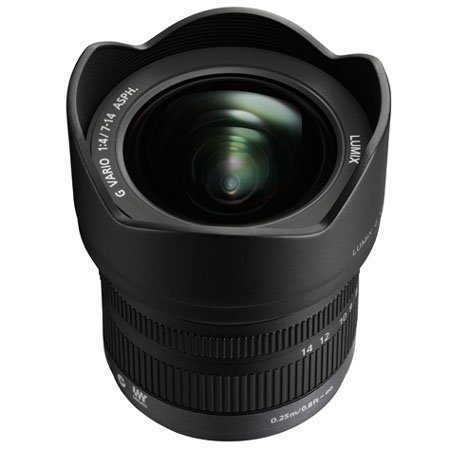
Panasonic 7-14mm f/4.0 Micro Four Thirds Lens for Panasonic Digital SLR Cameras Description:
For Lumix G1 & GH1 Digital SLR Cameras / 16 elements in 12 groups (2 Aspherical lenses, 4 ED lenses) / f=7mm to 14mm (focal length) / 7 diaphragm blades Contrast AF system support Utilizing a durable metal mount The optimally designed lens hood enables use even under strong sunlight Lens Construction - 16 elements in 12 groups (2 Aspherical lenses, 4 ED lenses) Micro Four Thirds mount Focal Length - f=7mm to 14mm (35mm film camera equivalent 14mm to 28mm) Aperture Type - 7 diaphragm blades / Circular aperture diaphragm Aperture Range - F4.0 Minimum Aperture - F22 Closest Focusing Distance - 0.25m / 0.8ft at all focal lengths Maximum Magnification - Approx. 0.08x / 0.15x (35mm film camera equivalent) Diagonal Angle of View - 114 (W)~75 (T) Max. Diameter - 70mm / 2.76 inch Overall Length - Approx. 83.1mm / 3.27 inch (from the top of the lens food to the base side of the lens mount) Weight - Approx. 300g / 10.58oz Accessories - Lens Cap, Lens Rear Cap, Lens Storage Bag
- Amazon Sales Rank: #3807 in Camera & Photo
- Brand: Panasonic
- Model: 7-14mm Micro Four Thirds
- Dimensions: 2.00 pounds
Features
- 2 Aspherical lenses and 4 ED lenses for superb optical performance
- Ultra wide-angle with 114 of diagonal angle of view at wide-end
- F4.0 brightness over the entire zoom range thanks to its large-diameter glass molded lens elements
- Circular aperture diaphragm
- Multi-coated lens elements minimize ghosts and flare
Customer Reviews:
Outstanding ultra-wide
How can this outstanding ultra wide micro four thirds lens not have any reviews? I’m not a professional photographer, but I can’t sit by idly while this lens is denied its proper accolades.
First, an ultra-wide lens is very useful. The difference between 7mm and 14mm is enormous. The broad field of view at 7mm lets you take amazing landscape pictures. More importantly, the ultra-wide angle lets you take close ups of objects while preserving their relationship to the objects around them. And most importantly, the ultra-wide angle lets you take pictures in close or cramped quarters that simply would not be possible with any other lens. At 9mm you can sit in the corner of a room and take a picture of the entire room!!! During filming, you can zoom out from 14mm to 7mm to create a dramatic effect that cannot be achieved with another lens.
Second, this is an excellent choice among all ultra-wides. slrgear tested it and found it to provide excellent image quality. It is ideally suited to the Panasonic G1/GH1/GF1 and the Olympus E-P1 because it is the only ultra-wide lens available for micro four thirds that will auto-focus and auto-expose during movies. Auto-focus and auto-exposure are quiet enough under normal conditions that I can’t hear them. Auto-focus hunting is minimal. As of firmware version 1.1 (dated 2009/11/25), this lens officially supports auto-focus in 1080p24 FHD movies. It is incredibly light (only 300 grams) when compared to similar lenses in other formats. The next most compact ultra-wide zoom is the otherwise excellent Olympus Zuiko 7-14mm f/4.0 Aspherical Super ED Lens for Olympus Digital SLR Cameras, which weighs 480g more (ie., 2.6x) and costs 700 dollars more.
Now the bad news…. Flash is problematic. The wide hood at the end of the lens blocks the on-camera flash in the wide field of view that this lens provides and will cast an ugly shadow right in the bottom middle in your frame. So if you take a flash picture with this lens, your picture will have a dark spot in the center bottom where the lens blocked the on-camera flash  I’m not sure if a hot-shoe mounted flash can solve this problem because I haven’t found any that are rated down to 7mm. This is annoying since at f4.0 this lens isn’t fast enough for low light photography without a flash.
And finally, my druthers. My favorite use of this lens is photographing tight indoor spaces, where I am always wishing for a faster lens. So I wish this lens was faster, even though it would be much more expensive. But even exactly as it is, it is hands-down my favorite m43rds lens. If you have a GH1 with the 14-140mm kit lens, I highly recommend this as your second lens.
Amazing lens and amazingly small…
This lens has been very hard to get for awhile now and it is certainly not cheap. It does, however, deliver the goods. It is a stunningly good performer and its diminutive size demonstrates the advantage the micro-four-thirds has in wide angle optics solutions with the elimination of the mirror-box. The G1+7-14 looks almost comically small sitting next to my Canon 400D+10-22 - and the 7-14 actually goes wider than the 10-22.
Please keep in mind that this is a UWA, so when I and other reviewers praise it we are doing so in the context of a UWA lens. That means expect the corners to not be perfectly sharp, no UWA lens achieves this. But this lens has great center sharpness and corner sharpness the keeps up with the best competition. Simply stunning results. If you’ve never shot UWA come to the table with the right expectations, if you have UWA experience I think you’ll be very impressed.
Flare performance is excellent, comparable to the Canon 10-22 which is another great flare performer.
Be advised, no filter attachment is practical with this lens. This is usually not a problem as polarizers are less frequently useful on UWA lenses (effect will vary dramatically over such a wide viewing angle) and for a digital camera few other filters are useful.
Is it worth the price? Well, that is a hard call as it is not a cheap lens. Right now it is your only option for micro-four-thirds. Comparing to other systems the Canon 10-22 is probably comparable and cheaper. So yes, I think you are paying a bit of a micro-four-thirds premium. That said, once you put it on a micro-four-thirds body and hold it in your hand and look at the results it is a whole new ball game to have something this small with such excellent UWA performance - there is nothing else like it out there. If you are a UWA shooter I strongly suspect you’ll find it well worth the cost, its portable size and tremendous performance make it a landscape or architecture photographers dream solution for compact/lightweight gear.
Finally, note that in early 2010 Olympus is planning on releasing a micro-four-thirds 9-18mm lens that will likely be significantly cheaper (probably 40% less). It of course won’t go as wide (and there is quite a difference between 7mm and 9mm) and will likely not be as good in the IQ department, but it will use a 52mm filter and might be a more attractive price point for many buyers. As far as that goes you can pry my 7-14 from my cold, dead fingers if you’d like to try…
A No Compromises Compact Ultra Wide
I wanted a high quality, lightweight ultra-wide lens to take hiking in the mountains of Colorado. The Lumix 7-14mm on my Panasonic GF1 replaces my previous UWA, the Sigma 10-20mm f4-5.6 that I used on my Nikon D300.
Advantages vs Sigma 10-20mmm f4-5.6
* Smaller and lighter
* Constant f4 aperture
* Better build quality
* Integrated lens hood
* Very sharp across the entire frame, even wide open
* Little barrel distortion @7mm.
Disadvantages vs Sigma 10-20mm f4-5.6
* Much more expensive
* No filter thread
I occasionally used a circular polarizer with my Sigma to increase color saturation and contrast, but the effect is pretty uneven on ultra wide lenses. The Lumix 7-14mm has very good contrast and color, so I don’t really miss the polarizer unless I want to reduce water reflections or glare from foliage.
If you shoot landscapes with a M4/3 camera, you’ll love this little gem!