Laser Eye Surgery And Dry Eyes
 Everyday, a large number of people live with an actual, medical condition referred to as dry eye. When an person’s eyes don’t generate a sufficient amount of tears to maintain adequate lubrication, dry eye occurs and there are many ways people experience this condition depending on the individual. Los Angeles eye surgeons explain that individuals with dry eye may experience a feeling of scratchiness in the eyes, a burning sensation, large amounts of mucous, sensitivity to wind and smoke, and increased light sensitivity. Oddly, individuals with dry eye may also experience excessive tears as the lacrimal glands, which produce tears, try to compensate for the lack of lubrication.
Laser-Assisted in Situ Keratomileusis, also known as Los Angeles Lasik eye surgery, is a procedure to correct vision in patients who experience myopia or nearsightedness, hyperopia or farsightedness, and astigmatism.
Among most people who undergo this surgery by a qualified, experienced Lasik surgeon Los Angeles patients end up with 20/20 vision or better without complications, however, LASIK can sometimes leave some patients with dry eye. This is especially true if the patient had dry eye prior to the surgery. In those cases, candidate screening was inadequate and the surgery should not have been done.
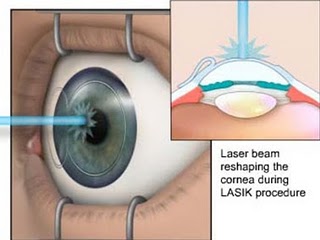
During Beverly Hills Lasik eye surgery, the surgeon cuts a thin corneal flap so the cornea can be reshaped underneath the flap using a laser. Creation of the flap inevitably cuts some of the corneal nerve fibers related to tear production. The lacrimal glands are beneath the upper eyelids and just below the eyebrows. They produce tears which flow through a drainage system and flush debris from the eyes. When these nerves are disrupted by flap creation, tear production is reduced and this happens in all Lasik procedures. In most cases the nerves regenerate within a few months and tear production becomes normal. In the meantime, moisturizing eyedrops are prescribed.
Usually dry eyes are a disqualifying condition for Lasik. But an eye surgeon will assess each individual and make a judgment call. It can be treated or managed. Prescription eyedrops can help. Your eye surgeon may insert plugs into the tear duct openings (the puncta; singular is punctum). These openings are in the inner corners of the eyes and allow tears to drain from the eyes into the nasal passages. Punctal plugs reduce tear drainage to keep the eyes better lubricated. Special lubricating drops may also be prescribed for people with mild dryness prior to Lasik surgery to minimize potential complications.
When considering Lasik eye surgery, be sure to inform your Lasik surgeon of your medical history, including any previous diagnosis of dry eye, as well as medications you are currently taking. This will help the surgeon provide you with the most effective, comfortable post-op experience possible. To find out if you are a candidate for Lasik eye surgery, the first step is to contact an experienced Lasik surgeon to learn more.