Just another Sleddoggin.com Blogs weblog

Archive for the ‘Beverly Hills Lasik’


LASIK: A Viable Choice for Patients Over 40

laser eye surgeryBaby boomers who want to rid themselves of their contact lenses should consider laser in-situ kertomileusis (LASIK) surgery as a viable option. Although LASIK traditionally has been considered less effective in individuals >40 years of age, a study shows new techniques offer better outcomes for middle aged and older patients.

In this retrospective consecutive case series, Ghanem et al from Harvard Medical School, Massachusetts, studied the outcomes in 710 eyes of 424 patients aged 40-69 years who underwent LASIK or laser eye surgery between 1999 and 2005.

The study group had refractive spherical errors ranging from -10.5 diopters (D) to +6 D and cylinder of up to 2.50 D. Patients were divided by age into 3 groups: 40-49 years, 50-59 years and 60-69 years. All LASIK procedures were performed by the same surgeon. Outcomes were analyzed for nearsightedness with or without astigmatism (511 eyes) and farsightedness with or without astigmatism (199 eyes) by Beverly Hills LASIK surgeons. Outcomes were based on postoperative follow-up visits of at least 6 months.

The study indicated postoperative safety, efficacy and predictability were comparable among all age groups. At the final follow-up, 80-100% of eyes in all groups had 20/30 or better uncorrected visual acuity and 81-90% were within ±1 D. In all 3 groups, 91-100% of patients achieved 20/40 or better visual acuity following LASIK.

Many LASIK patients in the study opted for monovision, a strategy that offers distinct advantages in addressing presbyopia, a condition often present in an older population. In monovision, one eye is corrected for distance vision, while the other eye is corrected for near vision, often eliminating the need for reading glasses. Researchers indicated that monovision can effectively compensate for the loss of accommodation that often occurs in older patients. The study concluded that despite challenges unique in the 40- to 69-year age group, Beverly Hills LASIK correction for nearsightedness and farsightedness has been reasonably safe, effective and predictable.

Ghanem RC, de la Cruz J, Tobaigy FM, et al. LASIK in the presbyopic age group: safety, efficacy, and predictability in 40- to 69-year-old patients. Ophthalmology 2007; 114:1303-1310.
Which Laser Eye Correction Treatment Is Best For Me?

Los Angeles eye surgeon

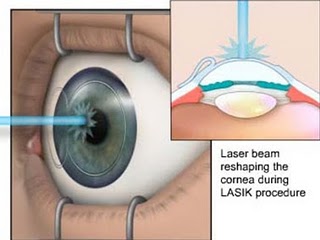
The most popular variation of laser treatment is called Lasik (for “laser in-situ keratomileusis”). In this technique, the Los Angeles eye surgeon applies the laser upon the cornea, rather than near the corneal surface. This is accomplished by creating a protective flap in the front 20-25% of the cornea and then applying the laser treatment to the tissue beneath the flap. This protective flap can be made with a laser or with a keratome.

The vision correction treatment can also be applied near the surface of the cornea (instead of under a protective flap), in which case the technique is referred to as Advanced Surface Treatment, or “Lasik without a flap”. This technique has several minor variations, which include PRK (for “photo-refractive keratectomy”), Lasek, and Epi-Lasik.

In PRK, the thin layer of soft tissue coating the outside of the eye (the epithelium) is removed and the Beverly Hills Lasik surgeon applies the laser energy to the firm tissue underneath.

In Lasek-with an “e”-the soft tissue on the surface is replaced after the laser treatment. In Epi-Lasik, this thin layer of soft material is folded back using a machine. PRK, Lasek, and Epi-Lasik are very similar to each other.

When the laser treatment is applied to the tissue deep within the cornea (as in Lasik) instead of near the surface (as in Advanced Surface Treatment), the healing is quicker with more rapid vision recovery. Patients usually see quite well the next day after a Los Angeles Lasik treatment. In “Lasik without a flap” the intial healing takes about a week. However, after the healing period is complete, the results are the same with each of these techniques.

Lasik requires an additional surgical step, which is the creation of the protective flap. The flap is created with an instrument known as a keratome or with the IntraLase laser. Creation of the flap takes about 15 seconds and is virtually painless. Complications with the flap occur about 1% of the time. Almost all of the complications are mild and can be easily treated, often by lifting or repositioning the flap. The most serious complication would involve improper creation of the flap; when this occurs, the patient is asked to wait three months, and then can return for a repeat treatment.

With either Beverly Hills Lasik or “Lasik without a flap”, there are two types of computer software that can be used, known as conventional and Custom. Both of these use the same laser to perform the vision correction treatment. The conventional software works like glasses or a contact lens; there is one prescription that covers the entire eye. Obviously, this produces excellent vision, just as do glasses and contact lenses. With Custom treatment, an additional modification is made in the treatment to account for additional irregularities in the vision. On average, the Custom treatments produce slightly better vision than the conventional software.

At the Caster Eye Center, we perform all of the variations of laser vision correction. All of the variations produce excellent vision. During your consultation, we will obtain measurements of your eyes, and Dr. Caster will personally talk to you and determine which procedure is the best for your specific situation. In this careful way, we obtain the best vision possible for our patients.

The Treatment Is Easy

Drawn from top Los Angeles eye surgeon Dr. Andrew Caster’s book Lasik: The Eye Laser Miracle, the following takes the patient step-by-step through the laser vision correction process from start to finish.

Los Angeles Lasik Laser Vision Correction Very Easy Procedure To Undergo

No injections are needed, and there is no pain during the procedure. These are the steps you will experience:

  1. 1. Your doctor will measure your eyes to determine your amount of nearsightedness, farsightedness, and astigmatism. During this presurgical consultation, your doctor will complete a thorough examination of the health of your eyes and discuss the procedure in detail with you.

2. The laser will be calibrated and tested for accuracy.

3. The correction desired for your eye will be entered into the laser’s omputer.

4. The computer will determine the specific set of laser pulses to apply.

5. You will be brought into the laser room and asked to lie down.

6. A patch will be placed over the eye not having the procedure.

7. Anesthetic eyedrops will be place in the eye. No injections or IVs are needed.

8. Your eyelid will be held open with a small speculum, which causes no pain.

9. You will be asked to look at a small blinking light.

10. In Lasik, a small layer of tissue, known as the corneal flap, will be separated and lifted. In PRK, the Beverly Hills Lasik surgeon will gently wipe away the soft, superficial layer covering the cornea.

11. You will hear a clicking noise, the sound of the laser.

12. The blinking light will get hazy as the treatment progresses.

13. The treatment will usually take less than thirty seconds of laser time.

14. Eyedrops will be placed in the eye. In some cases, a temporary contact lens will be placed in the eye as well.

15. In most cases, the procedure will then be repeated for the second eye.

16. You will sit up and rest for a few minutes before going home. Your stay in the treatment room has lasted about five to ten minutes.

Sounds easy, doesn’t it? And it is. But how accurate are the results? What can go wrong? Are you a suitable candidate for laser vision correction or should you consider alternatives? These questions can be effectively addressed by your Beverly Hills Lasik eye surgeon.