
Speak Out! It’s time to show your SUPPORT of the Iditarod and the sport of sled dog racing!
By wolfmoonsleddog on Mar 8, 2009 in Midwest
Location: Finland, MN
Time - 8:28pm Central Daylight Time
Temperature: 19 degrees F (-7 C)
Conditions: Few high clouds, cooler
Forecast: Mostly cloudy tonight and tomorrow with a chance of snow showers tomorrow. Lows in the teens to single digits, highs in the 30s
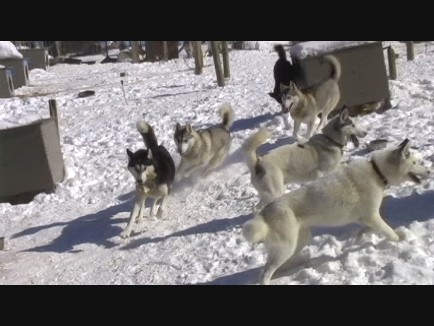
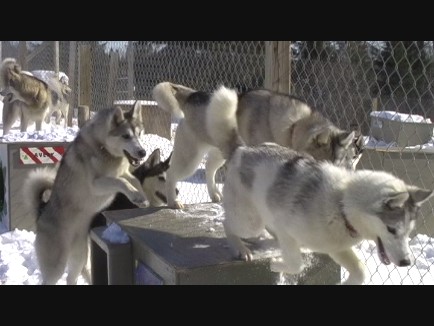
Abused, neglected dogs? More stills from video I took in the kennel.
In case you don’t know, the Iditarod starts today (and so does Daylight Savings Time).
In today’s edition of the Duluth News-Tribune, the front page of the Northland Forum section is dedicated to the sled dog controversy. The headline screams Are Dogs Being Raced To Death? and has a couple of pictures from the Beargrease. There are two articles on the page - one opposing sled dog racing (from PETA’s Jennifer O’Connor titled “Iditarod is brutal torture for dogs”) and one supporting the sport (written by Blake and Jen and titled “Well-being of every dog is mushers’ first concern”).
Obviously they are asking for a debate. I am including both articles at the bottom of this post.
Unfortunately the sponsors of the Iditarod receive a lot of negative emails this time of year - and yet many of those who support the race do not send them any thank-you notes! So this is a call to all of you -please let’s send emails to the Iditarod sponsors letting them know how much we appreciate their support of the event!
Letters needn’t be long - in fact short and to the point is better. Make it obvious from the title of the email that you are THANKING them for their sponsorship. And although it might be good to say you know they have been swamped with negative messages, don’t spend your email bashing those against the race, please try to keep it positive. If you have personal experience in the mushing world that is also good to include.
So here it is, the list of 2009 Iditarod sponsors that need to know you support the “Last Great Race” (thanks to June Price for this list!).
Aeromed International
[email protected]
Alaska Airlines
[email protected]
Alaska Mining & Diving Supply
[email protected]
Alaska Serigraphics
[email protected]
[email protected]
[email protected]
[email protected]
[email protected]
[email protected]
[email protected]
[email protected]
[email protected]
[email protected]
[email protected]
[email protected]
[email protected]
[email protected]
[email protected]
[email protected]
[email protected]
[email protected]
[email protected]
[email protected]
[email protected]
[email protected]
Target Corporation
Next are the articles from the Duluth News-Tribune. I encourage everyone to write a letter to the editor in support of mushing to help counter (and hopefully outnumber) any negative letters. Again, if you have personal experience with sled dogs, include that in your letter. Letters should be under 300 words and can be sent to [email protected]
From: http://www.duluthnewstribune.com/event/article/id/114342/group/home
Mushers’ view: Well-being of every dog is our first concern
During the nine to 13 days of the Iditarod, mushers work around the clock caring for their dogs.
By: Blake and Jen Freking,
At the White Mountain checkpoint last year, just 72 miles from the finish line in Nome, our teams were still barking and still jumping in their harnesses. With wagging tails and husky smiles, the dogs drove on to the finish line of the 1,039-mile journey across the great Alaskan wilderness known as the Iditarod Trail Sled Dog Race. Tears were in our eyes. We were so humbled and proud of these amazing animals we raised and trained from birth.
Many, if not all, of the 67 mushers who left Anchorage yesterday during the latest running of the Iditarod will soon be feeling much the same way as they pass over the Alaska Mountain Range, head down the mighty Yukon River, and race along the Bering Sea Coast. The amazing endurance and strength of racers and dogs are in stark contrast to claims of some critics that dogs are cruelly forced to participate.
Hardly. These dogs love to run. They are driven to run and pull just like Labradors are driven to retrieve and border collies are driven to herd. It is hard-wired into their instincts.
We have welcomed many people to watch as we start our young dogs in harnesses at about 6 months to 8 month of age. We allow them to slowly move forward, and it’s amazing, the pups lean into their harnesses and begin pulling and pulling, yipping and cheering and driving to go faster. These youngsters won’t be on serious race teams for two years, but immediately they’re hooked. Then they’re carefully trained and conditioned, just like any other athlete, as they develop strength and endurance and as they learn how to run as a team with other dogs.
In 20 years of raising and training sled dogs, we’ve never had a dog that didn’t love to run. In fact, one of the biggest challenges we face in guiding teams down a trail is managing their pace and keeping the dogs from running too fast.
The bond between musher and dog is amazing. Our dogs are like our children. The first question most people ask when they learn we own 80 huskies is, “Do they all have names?” Mushers’ lives revolve around their dogs. We live where we do — in the woods and off the power grid north of Finland, Minn. — because it is best for our dogs. We schedule our lives around what’s best for them. We know every one of them as unique individuals starting the day they’re born. Not only do they all have registered names and nicknames, they all know their names and come when called.
The health, well-being and happiness of dogs is every musher’s utmost concern. We strive every day, 365 days a year, to provide our dogs with the best nutrition, the best health care and the most comfortable environment possible. We strive to give them the best training and conditioning so they’re able to be the most successful team on the trail. We must be able to tell if anything is wrong with any member of the team before it becomes a serious problem. We are able to tell by the simple flick of an ear or tail or by the slightest change in a dog’s posture if something is off.
We are their coaches, nutritionists, therapists, health-care providers and, most importantly, best friends.
Trust is the most important aspect of our relationship. The dogs must know we would never ask them to do anything of which they weren’t capable.
During the nine to 13 days of the Iditarod, mushers work around the clock caring for their dogs. Mushers strive to ensure their teams get everything they need to perform their best. Mushers work to keep their dogs warm and dry, providing them ample straw and blankets so they can rest comfortably. They spend hours massaging their dogs’ muscles and feet, ensuring they are in excellent condition. Booties are used to protect the dogs’ feet from sharp snow and ice. Insulated jackets are used if conditions are cold and windy, and reflective jackets may be used to reflect the sun’s heat during long, sunny March days.
The Iditarod Veterinary Team is comprised of 50 of the most skilled sports-medicine veterinarians available. Prior to the Iditarod, every canine athlete receives a complete health work-up, including a thorough physical exam, blood work, and electrocardiogram. Veterinarians watch each team as they come in to the 23 checkpoints. Every dog receives a complete physical exam at every checkpoint to ensure no health problems are overlooked. Any dog deemed unfit to continue is left in the care of race veterinarians and flown back to the mushers’ handlers in Anchorage.
The Iditarod is a celebration of the amazing relationship between humans and dogs.
A dog cannot be forced to run.
Dogs run because they want to and because they are driven to see what is around the next bend in the trail or over the next hill. It is truly an honor they allow us to come along for the ride.
Veterans of the Iditarod race, Blake Freking is a Beargrease Sled Dog Marathon champion and Jen Freking is a veterinarian. Together, they operate Manitou Crossing Kennels in the woods north of Finland, Minn., www.racingsiberians.com.
Next is PETA’s article, which has been popping up in several places.
From: http://www.duluthnewstribune.com/event/article/id/114353/
PETA’s view: Iditarod is brutal torture for dogs
By: Jennifer O’Connor,
Imagine running four marathons a day for 11 days straight. Throw in biting winds, blinding snowstorms and sub-zero temperatures.
Unthinkable, isn’t it? Yet that’s exactly what dogs in the Iditarod will be forced to do in the next few weeks.
Dogs love to run, but even the most energetic dog wouldn’t choose to run more than 100 miles a day for 10 to 12 days straight while pulling heavy sleds through some of the worst weather conditions on the planet.
Along the 1,150-mile stretch, dogs’ feet are torn apart by ice and rocks. Many dogs pull muscles, incur stress fractures or become sick with diarrhea, dehydration, intestinal viruses or bleeding stomach ulcers. Some have died from inhaling their own vomit.
The Iditarod — and its cousin, the Yukon Quest — are life-and-death contests, but only for the four-legged participants.
No records were kept in the early days of the Iditarod, but before the start of 1997’s race, the Anchorage Daily News reported that “as many as 34 dogs died in the first two races” and that “at least 107 (dogs) have died” since the Iditarod’s inception.
In the 12 years since that report, at least 29 more dogs have died that we know of.
Mushers ride and sleep while dogs pull. In February’s Yukon Quest, two mushers — including four-time Iditarod champion Martin Buser — ran out of food for their dogs. Buser fed his dogs reduced rations; the other musher resorted to feeding his dogs melted snow.
Iditarod organizers downplay dogs’ suffering and work to hide abuses from the public. Even when mushers are caught beating dogs, as musher Ramy Brooks was in 2007, they barely receive a slap on the wrist.
One of Brooks’ dogs later died, but rather than banning this bully for life, the Iditarod committee will allow Brooks to race again.
Life for dogs behind the scenes is immeasurably grim. The vast majority of sled dogs live on short chains with only barrels or dilapidated doghouses for shelter.
They rarely know a kind word or a gentle touch, much less a belly rub or a warm snuggle on the couch. Dogs who aren’t fast runners, or who simply don’t have the inclination to participate, are discarded like defective equipment.
Just last month, the bodies of several dogs used in a sledding operation were found frozen to the ground in Tuktoyaktuk, Canada.
They had been chained, with no protection from the deadly weather as temperatures dipped below zero. Three other dogs were found still alive, also tethered without shelter and in bad shape.
Last February, Montana authorities seized 33 emaciated dogs that had allegedly been abandoned by an Iditarod musher. In March 2005, 11 abandoned sled dogs in Alaska were found after going more than a week without food or fresh water and more than a month in kennels that reeked of feces and urine.
Most kennels operate “under the radar” and are never inspected by any regulatory agency.
All over Alaska and Canada, animal shelters are overburdened with abandoned, neglected and surrendered sled dogs. Not every puppy is born a fast runner, and those who don’t make the grade are often dumped.
Others are killed outright — by bludgeoning or drowning — for not possessing monumental stamina and speed. Manuals and articles written by top mushers blatantly recommend killing dogs who do not measure up.
The Iditarod isn’t about honoring Alaskan culture or tradition. It’s a quest to win money, a truck and bragging rights.
But how can anyone brag about an event that causes so much suffering?
Jennifer O’Connor is an animals in entertainment campaign writer with People for the Ethical Treatment of Animals in Norfolk, Va.
Letters to the editor: [email protected]